THE FILM:
 As you may come to learn, Emeric Pressburger did not actually direct. As well, Michael Powell did not actually write. They simply were credited in the three categories of writer, producer and director. Therefore, it was Powell’s decision of who he would cast in the lead role. He initially wanted Laurence Oliver. This was a more than understandable desire considering Oliver has come to be known be many as a the greatest actor of all time. However, the Ministry of War refused to release Oliver from his military duty. What a pity. Instead, Roger Livesey was cast. After that, Anton Walbrook was cast. There is a famous exchange of dialogue between Walbrook and Wintston Churchill which I would like to shed some light on. Churchill stormed in on Walbrook while he was in his dressing room. Churchill declared “What’s this film supposed to mean? I suppose you regard it as good propaganda for England.” Walbrook glanced at him and replied with “No, people in the world other than the English would have had the courage, in the midst of war, to the people such unvarnished truth. This did not meet the approval of Chruchill. He denied Powell access to the military equipment that was needed for props. Powell claimed that to escape this situation… he stole the equipment.
The film was originally banned. After much protesting and reluctance, The Life and Death of Colonel Blimp was released in a much shorter version. In fact, in the United States, the film was released with the absence of approximately fifty minutes. It was also re-edited into a chronological story.
The Life and Death of Colonel Blimp is among the most essential films in the works of history. It’s reputation as the greatest British film is a very popular opinion. It remains among the most popular film of directors, Michael Powell and Emeric Pressburger. Where does The Life and Death of Colonel Blimp currently stand? The film has a 8.2 on IMDb. The best way to view the film would be on the Criterion Collection’s restoration.
THE PLOT:
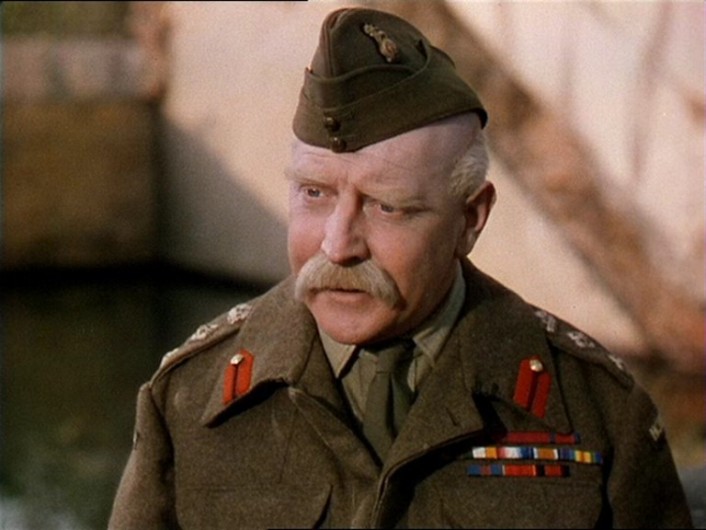
The film commences in a military training camp. It has just been announced the war is to begin at midnight. A group of young gung-ho military officers decide to cheat at war and attack the enemy before midnight. This would violate all the military rules. The troops barge into General Clive Wynne-Candy’s club where he is in the middle of enjoying a steam bath. The troops encircle him and try to take him into custody. As they do so, the General shouts about the injustice these troops are delivering. The leading lieutenant proceeds to insult the General’s large belly and ridiculous moustache. He then tackles the leading lieutenant. As he attacks, he pounces. This knocks not only him, but the lieutenant into a vast swimming pool.
We proceed into a long flashback where we watch the General slowly age. We draw comparisons to the soldiers who barged into his club and the younger version of himself.
 THE CRITISCIM:
The largest theme in the film The Life and Death of Colonel Blimp is certainly the theme of time and how it passes. We observe how exactly the transformation of General Clive Wynne-Candy occurred. There are many comparisons to how people age, and how the elderly were once young and like as all. It comments on how the younger generations should truly listen to the world of the elderly as they have experienced the same things and have words of wisdom. Yet, The Life and Death of Colonel Blimp also depicts the lack of honour that was lost in the generations. Even when General Wynee-Candy was younger, he may have been playful and careless, but he still lived by a code of honour. This concept of honour is lost among the young soldiers he sees in modern time. All of this is demonstrated to evoke the realistic life of General Wynee-Candy. This is a fabulous character analysis. Perhaps the deepest The Life and Death of Colonel Blimp gets is with his love life. The General is blinded by his love for a woman he met at the very beginning of the film. In his search for another woman who may perhaps act as a double for her, he stumbles into a metaphorical blindness. This theme is perhaps overdone when Deborah Kerr plays the other woman in the General’s life. This was a creative idea, but the multiple character aspect was slightly too overt for my liking.
Each frame of The Life and Death of Colonel Blimp is dealt with fabulous acting. Overall, the film is embellished in all-around solid acting. However, many may consider Roger Livesey to be the highlight of the film’s acting. I would personally beg to differ. The highlight of the film’s performances, for me, was with Deborah Kerr. She took on the challenge of pulling the strings between her multiple characters to have a compilation of necessary recurring details while making them unique enough to fully notice a difference among her characters. She clearly comprehended the essence of her character and her essential role to play with the character of General Clive Wynee-Candy. To speak frankly, The Life and Death of Colonel Blimp would have failed to live on as it did if I were not for Deborah Kerr.
Yes, The Life and Death of Colonel Blimp is another example of what a big budget in the hands of Michael Powell and Emeric Pressburger can get you. The film requires an elegant array of upper-class costumes. These costumes were perfectly selected to better match the characters and style in the film. On a similar note, the extravagant sets in the upper-class settings were extremely fitting. It is nearly impossible to create a film on such large a scale without the usage of humongous sets. In the state of mind, The Life and Death of Colonel Blimp nails it.
 In this film, Powell and Pressburger demonstrate their skill of physically positioning characters. I mean to speak of how exactly they have their actors positioned in separate angles and positions. The characters are layered in their positions and constantly are carefully placed in unique directions of the screen. I mean to explain how one character may be leaning against a wall at the back of the frame while another stands directly before the camera. This creates a layered effect that resonates throughout. However, I did notice one major fault in the direction of Powell and Pressburger. The Life and Death of Colonel Blimp suffers from camera angles and camera movements that are in no way innovative, or interesting for that matter. They knew how to use Technicolor, so they figured that they wouldn’t need to know how to use the camera to its best possible potential. I mean to speak of the manner in which the camera sits before the characters in close-ups and then cuts to a long shot. The camera only pans and never considers moving in any other motion. Using the camera was not exactly Powell and Pressburger’s strong suit.
There are many people who find The Life and Death of Colonel Blimp boring. I would not go to such extremes in any long shot, but The Life and Death of Colonel Blimp is slow at times. In an attempt to give us the full pictures of the General, the directors went overboard and gave us a little too much. This resulted in a fraction of our attention to be lost somewhere in the second third.
But The Life and Death of Colonel Blimp never delivers and drastic disappointments. After completing the film I found myself deeply satisfied with its ranking as a cinema classic.
The Life and Death of Colonel Blimp,
1943,
Directed by Michael Powell and Emeric Pressburger
Starring: Roger Livesey, Deborah Kerr and Anton Walbrook
8/10 (A-)
Ranked:
1. The Life and Death of Colonel Blimp
2. The Tales of Hoffman


